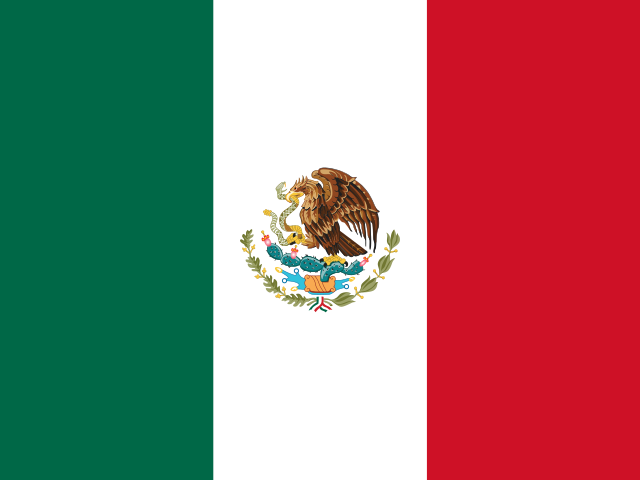
Mexico
MEXMexico borders the United States and functions as one of the most accessible destinations for North American retirees and remote workers, combining a very low cost of living (index 37) with straightforward income-based residency requirements. The economy is large and diversified, driven by manufacturing, nearshoring, and tourism. Taxation is residence-based with no foreign-income exemption, so residents face standard worldwide-income rules.
Core routes are the Temporary Resident visa (income or savings based, renewable toward permanent residence), a Retirement visa, and Permanent Resident status. The passport ranks 25th globally with visa-free access to around 133 destinations, and dual citizenship is permitted. English proficiency is relatively low (rank 83), so functional Spanish eases daily life outside expat enclaves.
Naturalisation requires 5 years. Healthcare (index 60) is mixed: private hospitals in major cities are affordable and well-regarded, while public care quality varies. Popular hubs include Mexico City, Oaxaca, Mérida, and Playa del Carmen, though personal safety varies significantly by state and warrants location-specific research.
- Naturalisation
- 5 years
- Tax system
- Residence Based
- Currency
- Mexican Peso (MXN)
- Dual citizenship
- Allowed
- Capital
- Mexico City
- Region
- americas
- Population
- 128,900,000
- Cost-of-living
- 37 /100
Passport Rank
#25
Visa-Free
133
destinations
Visa-free travel
A Mexico passport has visa-free access to 133 destinations. See the full Mexico passport breakdown →
Passports that enter Mexico without a prior visa (65)
Visa-free, visa on arrival, or on an eTA.







Community-sourced (passport-index, synced 2026-08-18) — verify with the embassy before travel.
Immigrating to Canada from Mexico
Current IRCC processing times for Mexico nationals, by application type.
| Visitor visa (outside Canada) | 21 days |
| Super visa | 78 days |
| Study permit | 3 weeks |
| Work permit | 2 weeks |
| Sponsor a dependent child | No processing time available |
| Adopted child (citizenship) | Not enough data |
| Government-assisted refugees | Not enough data |
| Privately sponsored refugees | sponsor: Not enough data / refugee: Not enough data |
Your application may take longer than the times shown here. They’re not a maximum or a guarantee.
As of 2026-10-07 (IRCC). See all Canada processing times →
Source: Immigration, Refugees and Citizenship Canada — “Check processing times”. This is a copy of the version available at https://www.canada.ca/en/immigration-refugees-citizenship/services/application/check-processing-times.html. Reproduced under the Government of Canada’s non-commercial reproduction terms; not endorsed by or affiliated with IRCC.
Sources & last verified
Government of Canada — non-commercial reproduction (canada.ca Terms and conditions)
Country Details
- Capital
- Mexico City
- Currency
- Mexican Peso (MXN)
- Languages
- Spanish
- Population
- 128,900,000
- Tax System
- Residence Based
- Dual Citizenship
- Allowed
- Naturalisation
- 5 years
- Schengen / EU
- No
- Climate
- Tropical / Desert / Temperate
- English Proficiency Rank
- #83
- GDP per capita
- $13,889
- Life expectancy
- 75.26 yrs
- Population growth
- 0.83%/yr
GDP per capita, life expectancy, and population growth: World Bank (2025).
Indices
Cost of Living
37
Safety
40
Healthcare
60
Quality of Life
142
Tax Summary
- Tax System
- Residence Based
- Territorial Taxation
- No — worldwide income taxed for residents
- Naturalisation
- 5 years of legal residency
- Dual Citizenship
- Allowed
Cost of Living by City
← scroll the table →
| City | Rent 1BR centre | Rent outside | Groceries | Utilities | Transit pass |
|---|---|---|---|---|---|
| Mexico City (CDMX) | $950 | $620 | $280 | $60 | $15 |
| Guadalajara | $700 | $480 | $250 | $55 | $14 |
| Monterrey | $800 | $530 | $270 | $70 | $14 |
| Playa del Carmen | $900 | $600 | $290 | $80 | $12 |
| San Miguel de Allende | $1,000 | $700 | $300 | $65 | $10 |
Monthly USD figures. Typical central 1-bedroom rent, grocery basket for one, household utilities, monthly transit pass.
Climate
Mexico City
Rainfall range: 7–157 mm/month · Daylight 11h (winter) to 13h (summer)
Guadalajara
Rainfall range: 7–254 mm/month · Daylight 11h (winter) to 13h (summer)
Playa del Carmen
Rainfall range: 35–218 mm/month · Daylight 11h (winter) to 13h (summer)
Visa Categories & Immigration Authority
Major Visa Categories
- Visitor (FMM / Forma Migratoria Múltiple)
- Temporary Resident
- Temporary Resident Student
- Permanent Resident
- Family Unity
- Rentista
- Worker
- Humanitarian
- Authority
- Instituto Nacional de Migración (INM)
- Official Portal
- www.inm.gob.mx
- Phone
- +52 800 004 6264
- contacto@inm.gob.mx
Naturalisation Details
- Residence Years
- 5
- Language Test
- Yes (A2)
- Civic Test
- Yes
- Oath Required
- Yes
- Dual Allowed
- Yes
- Fee
- $150
- Processing
- ~12 months
Real Estate
- Avg price/sqm (capital)
- $3,200
- Transaction taxes
- 5%
Foreign buyers: Foreigners may not directly own property within 50 km of a coastline or 100 km of a border (restricted zone) — instead, a bank trust (fideicomiso) is used, renewable every 50 years. Outside restricted zones, direct ownership is permitted. CDMX typical price $2,500–$4,000/sqm.
International Schools
← scroll the table →
| School | City | Curriculum | Tuition (USD/yr) |
|---|---|---|---|
| American School Foundation (ASF) | Mexico City | American / IB | $15,000–$25,000 |
| Greengates School | Mexico City | British | $12,000–$20,000 |
Daily Life Logistics
Internet
100 Mbps median
55% fibre coverage
eSIM: Telcel, AT&T Mexico, Movistar MX
Driving
IDP required
Exchange eligible: No formal exchange treaty; foreign licence valid with IDP. Residents must obtain Mexican licence after establishing residency.
Pet Relocation
Quarantine: none
Rabies titre not required
EU pet passport: not accepted
Safety
GPI Rank
#140
Global Peace Index ranking (lower is safer)
Common Risks
- ⚠Express kidnapping in taxis (use Uber/DiDi only)
- ⚠ATM card skimming
- ⚠police extortion in tourist areas
- ⚠overcharging at border crossings
Examples of areas to avoid: Tepito (CDMX), Iztapalapa periphery, Cancún Hotel Zone backstreets at night
LGBTQ+ Legal Status
- Same-Sex Marriage
- Legal
- Civil Partnerships
- Recognised
- Anti-Discrimination Law
- Yes
- ILGA Rank
- #42
Religious Life
- Halal Food
- Limited
- Kosher Food
- Widely available
- Prayer Facilities
- Limited
Sample Citizenship Test Questions
Q1. In what year did Mexico gain independence from Spain?
Answer: 1821
Source: Secretaría de Relaciones Exteriores Naturalisation Guidelines
Q2. What is the official name of Mexico's constitution currently in force?
Answer: Constitution of 1917
Source: Secretaría de Relaciones Exteriores Naturalisation Guidelines
Q3. How many states does Mexico have?
Answer: 31
Source: Secretaría de Relaciones Exteriores Naturalisation Guidelines
Regulators & official sources
Bodies that regulate immigration advice in Mexico, and the official sources indexed for it by Visa Atlas. Descriptions are verbatim; each links to its source.
Barra Mexicana, Colegio de Abogados
BMANational professional bar association; Mexican legal practice is licensed and supervised under state and federal professional rules.
Related Guides
Related on The Citizenship Desk
Visa Programs
Mexico Temporary Resident Visa
Mexico MEX
Est. processing
~1mo
Min. Income
$1,620/mo
Citizenship
5y
Verified 2026-04-20
Mexico Temporary Resident Visa (Retirement)
Mexico MEX
Est. processing
~2mo
Min. Income
$2,800/mo
Citizenship
5y
Verified 2026-04-20
Mexico Permanent Resident Card (Residente Permanente)
Mexico MEX
Est. processing
~2mo
Min. Income
$5,000/mo
Citizenship
5y
Verified 2026-06-01
Hospitals
Hospital Angeles Tijuana
Tijuana, Mexico MEX
Christus Muguerza Hospital Alta Especialidad
Monterrey, Mexico MEX
Centro Médico ABC (American British Cowdray Medical Center)
Mexico City, Mexico MEX
Centro Médico ABC Campus Santa Fe
Mexico City, Mexico MEX
Hospital San José Tec de Monterrey
Monterrey, Mexico MEX
Citizenship by Descent
Banking Options Based in Mexico
Sources & last verified
- Last verified