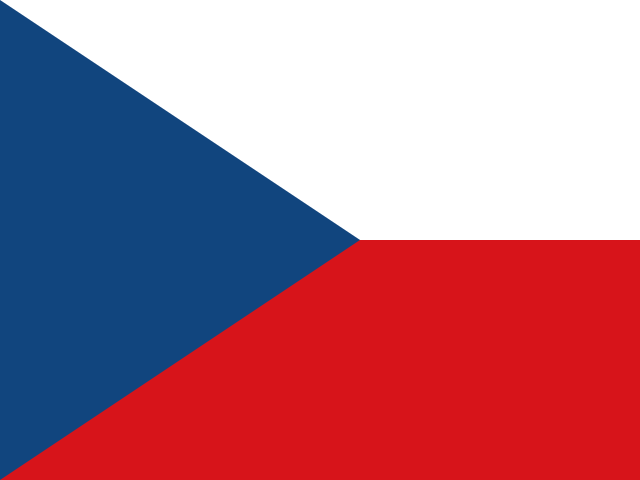
Czech Republic
CZECzech Republic sits at the heart of Central Europe as an EU and Schengen member, offering an established route to a top-tier European passport for skilled workers, entrepreneurs, and remote professionals. The economy centres on advanced manufacturing (notably automotive) and a growing Prague tech scene. Taxation is residence-based with no non-habitual-resident regime, so worldwide income faces standard treatment once tax-resident.
Main routes are the Employment Card, a Long-Term Residence permit for investors, and a Digital Nomad visa; citizenship by descent is available for those with Czech ancestry. The passport ranks 7th globally with visa-free access to around 155 destinations, and dual citizenship has been permitted since a 2014 reform.
English proficiency is strong (rank 15) among younger urban professionals, though bureaucracy runs in Czech. Naturalisation requires 10 years. Healthcare (index 75) is solid and affordable by Western European standards, and the cost of living (index 42) is well below Western Europe, with Prague costlier than Brno. Foreigners face no restrictions on residential property purchase, and safety (GPI rank 8) is among Europe's best.
- Naturalisation
- 10 years
- Tax system
- Residence Based
- Currency
- Czech koruna (CZK)
- Dual citizenship
- Allowed
- Capital
- Prague
- Region
- europe
- Population
- 10,516,000
- Cost-of-living
- 42 /100
Passport Rank
#7
Visa-Free
155
destinations
Visa-free travel
A Czech Republic passport has visa-free access to 155 destinations. See the full Czech Republic passport breakdown →
Passports that enter Czech Republic without a prior visa (91)
Visa-free, visa on arrival, or on an eTA.







Community-sourced (passport-index, synced 2026-08-18) — verify with the embassy before travel.
Immigrating to Canada from Czech Republic
Current IRCC processing times for Czech Republic nationals, by application type.
| Visitor visa (outside Canada) | 30 days |
| Super visa | No processing time available |
| Study permit | 4 weeks |
| Work permit | No processing time available |
| Sponsor a dependent child | No processing time available |
| Adopted child (citizenship) | Not enough data |
| Government-assisted refugees | Not enough data |
| Privately sponsored refugees | sponsor: Not enough data / refugee: Not enough data |
Your application may take longer than the times shown here. They’re not a maximum or a guarantee.
As of 2026-09-22 (IRCC). See all Canada processing times →
Source: Immigration, Refugees and Citizenship Canada — “Check processing times”. This is a copy of the version available at https://www.canada.ca/en/immigration-refugees-citizenship/services/application/check-processing-times.html. Reproduced under the Government of Canada’s non-commercial reproduction terms; not endorsed by or affiliated with IRCC.
Sources & last verified
Government of Canada — non-commercial reproduction (canada.ca Terms and conditions)
Country Details
- Capital
- Prague
- Currency
- Czech koruna (CZK)
- Languages
- Czech
- Population
- 10,516,000
- Tax System
- Residence Based
- Dual Citizenship
- Allowed
- Naturalisation
- 10 years
- Schengen / EU
- Schengen / EU
- Climate
- continental
- English Proficiency Rank
- #15
- GDP per capita
- $35,917
- Life expectancy
- 79.98 yrs
- Population growth
- -0.17%/yr
GDP per capita, life expectancy, and population growth: World Bank (2025).
Indices
Cost of Living
42
Safety
78
Healthcare
75
Quality of Life
175
Tax Summary
- Tax System
- Residence Based
- Territorial Taxation
- No — worldwide income taxed for residents
- Naturalisation
- 10 years of legal residency
- Dual Citizenship
- Allowed
Cost of Living by City
← scroll the table →
| City | Rent 1BR centre | Rent outside | Groceries | Utilities | Transit pass |
|---|---|---|---|---|---|
| Prague | $1,100 | $800 | $340 | $210 | $24 |
| Brno | $750 | $550 | $320 | $180 | $24 |
Monthly USD figures. Typical central 1-bedroom rent, grocery basket for one, household utilities, monthly transit pass.
Climate
Prague
Rainfall range: 24–74 mm/month · Daylight 8h (winter) to 16h (summer)
Visa Categories & Immigration Authority
Major Visa Categories
- Schengen C
- Long-term Visa
- Long-term Residence Permit
- Employee Card
- EU Blue Card
- Intra-company Transferee Card
- Student Residence Permit
- Family Reunification Permit
- Authority
- Ministry of the Interior - Department for Asylum and Migration Policy
- Official Portal
- www.mvcr.cz
- Phone
- +420 974 832 786
- posta@mvcr.cz
Naturalisation Details
- Residence Years
- 10
- Language Test
- Yes (B1)
- Civic Test
- Yes
- Oath Required
- Yes
- Dual Allowed
- Yes
- Fee
- $100
- Processing
- ~18 months
Real Estate
- Avg price/sqm (capital)
- $5,500
- Transaction taxes
- 0%
Foreign buyers: EU/EEA nationals unrestricted. Non-EU buyers may purchase freely since 2009 amendment to the Foreign Exchange Act. Prague €4,500-€6,500/sqm; regional cities much lower. 4% real-estate transfer tax was abolished in 2020.
International Schools
← scroll the table →
| School | City | Curriculum | Tuition (USD/yr) |
|---|---|---|---|
| International School of Prague | Prague | IB | $18,000–$27,000 |
Daily Life Logistics
Internet
150 Mbps median
55% fibre coverage
eSIM: T-Mobile CZ, O2 CZ, Vodafone CZ
Driving
IDP not required
Local licence required after 6 months
Exchange eligible: EU/EEA, UK, USA (state-by-state) +4 more
Pet Relocation
Quarantine: none
Rabies titre not required
EU pet passport: accepted
Safety
GPI Rank
#8
Global Peace Index ranking (lower is safer)
Common Risks
- ⚠taxi overcharging at Prague airport and Old Town
- ⚠currency-exchange scams (tourist-trap exchange offices)
- ⚠pickpocketing on trams around Wenceslas Square
Examples of areas to avoid: specific pockets of Prague 5 and 8 late night
LGBTQ+ Legal Status
- Same-Sex Marriage
- Not legal
- Civil Partnerships
- Recognised
- Anti-Discrimination Law
- Yes
- ILGA Rank
- #24
Religious Life
- Halal Food
- Limited
- Kosher Food
- Limited
- Prayer Facilities
- Limited
Sample Citizenship Test Questions
Q1. Who was the first president of Czechoslovakia?
Answer: Tomáš Garrigue Masaryk
Source: Czech citizenship civics test
Q2. In which year did the Czech Republic join the European Union?
Answer: 2004
Source: Czech citizenship civics test
Regulators & official sources
Bodies that regulate immigration advice in Czech Republic, and the official sources indexed for it by Visa Atlas. Descriptions are verbatim; each links to its source.
Czech Bar Association
CBARegulates Czech attorneys (advokati) authorised to provide legal services.
Related Guides
Fastest paths to an EU passport in 2025
A sourced comparison of the shortest EU naturalisation timelines, from 2-year descent fast-tracks to 5-year residency routes — plus the hidden requirements that extend them in practice.
Exit tax: countries that charge you to leave
Country-by-country reference of departure taxes, deemed-disposition rules, and wealth-locking regimes that trigger when tax residency ends.
Related on The Citizenship Desk
Visa Programs
Czech Employment Card
Czech Republic CZE
Est. processing
~3mo
Min. Income
—
Citizenship
10y
Verified 2026-05-05
Czech Long-Term Residence — Investment / Business
Czech Republic CZE
Est. processing
~4mo
Min. Income
—
Citizenship
10y
Verified 2026-05-05
Czech Digital Nomad Visa
Czech Republic CZE
Est. processing
~2mo
Min. Income
$2,300/mo
Citizenship
10y
Verified 2026-05-05
Citizenship by Descent
Sources & last verified
- Last verified